|
"Your lungs are
full of dog hair. You will see. During autopsy. Believe
me, bring that 'horse' to the shelter while it's not too
late," grumbled my neighbor pathologist in the elevator
[while] moving away from my German Shepherd dog. I don't
care what they find in my lungs during autopsy. I just
love her. Maybe I am crazy. I don't know. But I definitely
know that I am not alone.
In Roza Galieva's lungs
there is no less magnesium than there is dog hair in mine.
She could hammer nails with her callouses and her tired
joints moan and squeak like loose bars. When her nerves
can't take pain, bad luck and rumors, she slams the doors
to the gym. For good. That's how it seems to her. To leave
forever is more painful than to stay. She came back even
after her rival's hands almost cut the thin thread between
life and death. Her rival, just like Roza, loved gymnastics
and wanted to stand on the top of the pedestal. Roza was
in the way.
|
|
| |
|
|
|
|
Every
day this national team gymnast asserts her right to life.
|
|
| Issyk
Kul with Character |
| There was nothing to watch and
the TV was talking to itself out of habit. Looking at the screen
once in a while, Ilfat Galiev saw moving faces, hands, funny ponytails.
Then all of a sudden, a close up of a small "sparrow."
[She] scrunched her face, wiped her nose, leaving a white smudge
of magnesium, spit on her hands and flew up over the mat. After
landing, she cried for a minute, like a kindergartener, and smiled
right away. The sparrow's name was Masha Filatova and that was her
winning FX. Ilfat Galiev's heart skipped a beat from her defenselessness
and he "fell in love" with her at first glance. He decided
that his daughter will be a gymnast. |
| |
| He brought Roza to a gym. Roza
did not share her father's love [for gymnastics], stubbornly refused
to enter and when that did not help, cried repeatedly, "I don't
want to, I don't want to," and ran away. The next day, Roza's
heart melted from ice cream promised to her and she walked into
the gym. |
| |
| All gymnastics roads lead to Lake
Krugloye in the Moscow suburbs. A gifted child was noticed, and
she started working with a personal coach, ironically also [named]
Roza (full name: Roza Borisovna Ishkova). Soon the two Rozas from
Almalyk, Uzbekistan started walking the well worn road to life in
big time gymnastics. |
|
|
|
|
|
Young
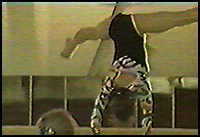
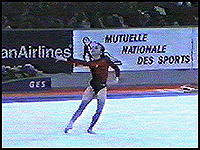
Roza trains at Round Lake.
|
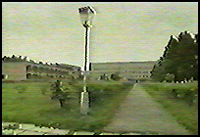
Round
Lake - The National Training Center
|
|
|
| During the first days in Round
Lake, Roza ran into The Goddess (Svetlana Boginskaya). During the
morning jog, Roza started overtaking Boginskaya, who was first,
and she shoved Roza with her elbow and she fell. But the next day,
Roza achieved what she wanted and came in first. The team's head
coach (Alexander) Alexandrov then said "You, Issyk Kul (he
could not remember Almalyk), have character as it turns out." |
| |
| The Little
Girl and Death |
| At 14, Roza is going to her first
World Championship in Indianapolis. The Soviet team wins gold. Roza
is very happy and, naturally, is dreaming of a medal in the AA.
But, as a newcomer, she competes only during team competition. |
| |
| The next year, in France, she
had a chance for gold. After the first day of the competition, Roza
was leading. She was sitting in her best friend's hotel room and
shared her happiness and dreamed about tomorrow's competition. She
was very thirsty and a glass of cold mineral water came in handy.
''This French mineral water sure tastes strange..." |
| |
| For three days Roza was between
life and death. Team doctors gave the correct diagnosis right away
as drug (medicine) overdose.They were afraid to bring her to the
hospital. SCANDAL! Thank God, they were able to take care of it themselves. Roza
regained consciousness in her hotel room. "I woke up, but it
seemed that my hands are covered with blood and big spiders are
crawling all over me and someone is trying to cut my head off. I
thought I was dying." |
|
|
|
|
|
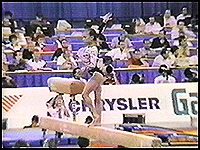
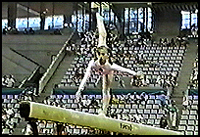
Roza
on beam at Indianapolis.
|
Preliminaries
at Paris Worlds 1992.
|
|
|
| First question: what did you drink?
"They decided that I took diuretics to lose weight or laxatives.
I tried to convince them that it's not true. Nobody believed me.
But I am not a fool to take a handful of pills especially on the
eve of the World Championships, before doping control." |
| |
| She came back to Krugloye and
together with Roza Borisovna (she was not in France with Roza) started
going over [recalling] the entire day. "I did not remember
it well. But once I dreamed about mineral water with a strange taste.
I told Alexandrov about my suspicions. But again nobody believed
me." They even found a psychiatrist who tried to convince Roza
that she was deeply mistaken. Roza thought that she was losing her
mind. And then the coach [Roza Borisovna] found another psychiatrist
through her friends. "I did not believe anything anymore. I
just went to see him so as not to hurt Roza Borisovna's feelings.
As soon as I started telling him what happened, he described the
whole thing right away. It turns out I was given medication used
to treat alcoholism. I started laughing that I don't drink. 'Don't
laugh,' he interrupted me, '[It was a] huge dose... It's a miracle
that you survived.'" Roza, happy that she was proven right
and not emotionally disturbed, came back to Krugloye to pick up
her things. And to ask her friend "Why ?" She did not
reply [but] just looked away. |
| |
| The two Rozas returned to Almalyk. |
| |
| Stolen Olympiad |
| [For the] whole month, Roza enjoyed
her freedom. She did not even think about gymnastics or team or
exhausting competitions. She was fed up and did not need this anymore.
But on TV for some reason they started mentioning the Barcelona
Olympics more and more often. Oh yes, there is less than 2 months
until it starts. You don't want it? It does not make sense to lie
to yourself. She called Alexandrov. "If you are in the top
six at the Nationals you can count on being on the Olympic team."
Roza came in second. She was on the team. She forgave everything.
"I realized that if I don't forgive, I won't be able to be
on the same team with her. Moreoever, she feels worse about it than
I do. She will have to live with this her entire life and remember
what she did and what could have happened. It's not easy to live
with those thoughts." |
| |
| Barcelona |
| Our team has [won the] gold and
Roza is a leader in the AA (she is 8th after team optionals). Tomorrow
she can become an Olympic champion. That night, coach Alexandrov
came in her room and announced his decision. Instead of Galieva,
he is putting Tatiana Gutsu into AA competition. For that, she will
share her prize money with Roza. Officially, they will blame it
on Roza's 'injury.' Roza declined. They told her to think it over
until morning, even though Alexandrov knew that everything will
be done according to his wishes. "I called Roza Borisovna (who
did not have accreditation and paid her way to Barcelona with her
own money), she was quiet and then said that she will call me back.
I waited for her call and was sure that she will support me. Instead
I heard 'Roza, do as you are told. It will be for the better.' I
was afraid of the repeat of France." After a sleepless night
that seemed to last forever, Galieva announced her consent. None
of the girls knew what happened that night. They sympathized with
'injured' Roza and cheered for Gutsu. Roza could not look at the
podium because of tears in her eyes. Her friends' reaction told
her that Gutsu was leading. When Gutsu cried from happiness on top
of the pedestal, Roza ran out of the arena. "I was mad at myself
for agreeing with my coach, for listening to him. It seemed that
I could still change everything. But I understood that nothing could
be changed anymore." |
|
|
|
|
|
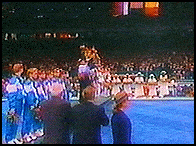
Roza
kicks butt in Barcelona.
|
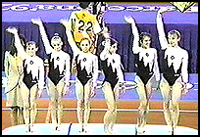
The
Unified Team wins gold.
|
|
|
| After the Olympics, Galieva competed
in a few meets and worked in the gymnastics show ran by Dmitry Bilozerchev,
who promised to pay her well. By the way, Gutsu gave her half of
her Barcelona prize. At first Roza would not take it. "But
the coach (Roza Borisovna) said: 'Take it, you don't know what will
happen tomorrow.'" 'Tomorrow' [as it turns out] the show bombed,
Bilozerchev left for the USA, and Roza Borisovna signed a contract
to work in Portugal. Galieva was left alone. |
| |
| Almalyk |
| [Does Galieva feel her] coach
betrayed her? "No, Roza Borisovna to me is a saint. It's just
that sometimes close relationships become unbearable. After the
Olympics, she felt guilty, was nervous and avoiding me. It was difficult
and we decided to part ways. I am not blaming her". Several
years after the Olympics, Alexandrov told me "Galieva and Gutsu
were equally prepared, they both were capable of winning gold. But
Gutsu's coach convinced me that Tatyana is more stable. And I was
forced to make this decision. Gutsu's coach lived in the Olympic
village together with the gymnasts. |
| |
| |
| Roza defeated?
(Literal translation: They Broke Roza?) |
| In Almalyk, Roza abandoned her
training again. There was nobody to train with and no reason to
train. She had money, friends...what else do you need at 17 ? Time
was flying, life was passing her by. She told herself she had enough.
But there was still some character left in 'Issyk Kul.' "I
felt that I had not realized my potential yet, that I can still
achieve a lot in gymnastics." |
| |
| There was less than a year left
till the Olympics in Atlanta. Leonid Arkayev was now the head coach.
Galieva needed gymnastics. Arkayev needed a gymnast with Olympic
experience. Their interests coincided. Arkayev brings 'out-of-shape'
Galieva, who is 10 kilograms overweight, to Krugloye and becomes
her personal coach. "Leonid Yakovlevich understood me and believed
in me". Nobody knew how difficult it was for her. Not physically.
She was used to hard work. [But] the new team hated Galieva. Of
course. They, who worked in Krugloye the whole Olympic cycle, are
not guaranteed a place on the team. But she came out of nowhere,
and even though she is an Olympic champion, she is already is on
the team. She is Arkayev's favorite gymnast. Arkayev patted her
on the shoulder. He helped her put her sneakers on. Krugloye was
full of rumors. "I felt them looking at me behind my back,
heard rumors. But I could not care less." |
| |
| Like a trampoline, rumors bounced
Galieva higher and higher. "Every difficult skill that I learned
proved that I belong on the team." Galieva became the national
champion. She was going to Atlanta as team captain despite the team's
opinion. Only after the Olympics did Svetlana Khorkina admit, "Roza
helped us a lot, it would be hard without her." |
| |
| Atlanta met Galieva with one question:
"Did you really sell the Barcelona Olympics? If you had to
do it over again, would you do the same?" Roza did not understand
anything. But it was simple. Guselkina (that's what the team called
Gutsu) lives in America now. Waking up, forgotten by everybody after
a 4-year post Olympics sleep, she confused everyone about who was
right and who was wrong [in Barcelona]. "Galieva sold me the
Olympics," that's the meaning of all of Gutsu's interviews. |
| |
| "She is just jealous that
I am still competing. A second Olympics is such a rarity for a gymnast."
But nobody is taking this chance away from her. "Everything
is up to you." |
|
|
|
|
|
Atlanta
proved difficult for Roza.
|
The
Russians win silver.
|
|
|
| From Atlanta, Galieva brought
a team silver. "Sometimes we did not believe that we could
win a medal. Silver - we were very fortunate." Galieva did
not win any individual medals. "On the vault, I could have
gotten bronze. But the judges underscored me. Why? I don't know."
Maybe Guselkina's interviews cost Galieva thousandths of a point
so valuable in gymnastics. Judges can read too. American fans, obsessed
with gymnastics, definitely read the interviews. Galieva was the
most disliked non-American. When she was performing, they screamed
out insults. "I was on the beam while they were booing and
whistling (whistling in Russia is like booing in the USA - Yulia).
I could not concentrate. I don't even know how I fell. I finished
my combination like in a vacuum." |
| |
| Atlanta for Galieva was disappointment
and pain. In Sheremetevo [the airport in Moscow], Roza was empty.
"I am tired living like this. I don't want anything anymore." |
| |
| After the Olympics Roza, as usual,
quit. At the nationals in March [1997] she already had a job, she
passed exams with the highest mark and became a judge. But... according
to new rules only girls 16 and over are allowed to compete in Worlds
and Olympics. There are not many good gymnasts of that age on the
team. So, Galieva came back. "I have to get lucky sometimes.
It's impossible that life always turns its back on you, right ?"
In August, Lausanne[Switzerland] will host the World Championships
[of Gymnastics]. |
|
|
Valentina Krasnykh
|
|
Translation
by 'Yulia,' 'sarah', and 'Andrei!'
|
|
Pictures from
'More Than Just a Game,' Sports Image, 1992 Olympic triplecast,
GymCan, TV Azteca, and NBC.
|